TL;DR
For US startups, the best design subscription is the one that preserves craft while removing vendor handoffs—not simply the cheapest monthly plan. Current options span from $699/month at ManyPixels and £599/month billed quarterly at DesignGuru to a $15,000 monthly minimum at Superside. Prioritise team continuity, the formats included and how many workstreams can move at once; price only matters after those three fit your actual creative queue.
For US startups comparing the best design subscription services in 2026, the useful comparison is no longer “unlimited design for the lowest monthly price”. The category has become too varied for that. Some subscriptions give you one daily design output. Others run several workstreams in parallel. Some cover graphics and web; others extend into video, motion, 3D and full creative production.
The operational unit that matters is the workstream, not the request. A plan can let you submit unlimited briefs while still moving only one or two through production at a time. And when the same team stays close to your brand, revisions tend to become refinement rather than repeated re-explanation.
Pricing and competitor plan details below were checked against official provider sources on 8 September 2026.
The best design subscription services for US startups at a glance
Service | Best fit | Published starting price | Quality and continuity model | Scope at entry | Production model |
|---|---|---|---|---|---|
DesignGuru | Startups needing consistent work across multiple creative formats | £599/month billed quarterly or £749 billed monthly | Senior in-house creative team, dedicated project manager and brand continuity | Static, brand, print and web graphics; video and motion from Pro | Unlimited briefs and revisions processed through a prioritised queue |
ManyPixels | Startups wanting strong graphic and web coverage at a low entry price | $699/month | Managed design team with project manager and quality control | Graphic design, web design and illustration | One daily output on Advanced (ManyPixels) |
Penji | Marketing teams wanting multiple active design workstreams | $995/month | Art director plus assigned in-house creatives | Branding, ads, social, email, print and presentations | Two active workstreams on Essentials (Penji) |
Kimp | Content-heavy teams producing both graphics and video | $1,397/month for Graphics; $1,697 combined | Dedicated project manager and design team | Graphics, or graphics plus video on combined plan | Three graphics requests in progress; combined plan adds two video requests (Kimp) |
Design Pickle | Teams that prefer allocated creative capacity and a mature workflow platform | Quote only | Creative capacity sized around the account | Broad design, motion and video scope | Daily creative hours; quarterly or annual billing (Design Pickle) |
Superside | Well-funded scale-ups and enterprise creative teams | $15,000 monthly minimum on an annual term | Managed global creative organisation with specialist depth | Full creative production, strategy, video, 3D, UI/UX and more | Flexible budget/capacity model (Superside) |
The table makes one thing clear: “design subscription” now describes several quite different operating models. A startup choosing between $699 and $1,700 plans is making a different decision from a scale-up considering a $15,000-a-month enterprise creative partner.
How we ranked the best startup design subscriptions
We put quality and creative continuity first. Price matters, but saving $300 a month is not much of a win if your founder deck, paid ads and landing pages look like three different companies made them.
Continuity matters because creative work compounds. A team that already understands your typography, positioning, visual hierarchy, product and previous feedback has less discovery to repeat on the next brief. Revision depth matters for the same reason: the first draft is only part of the quality equation.
After craft, we compared five practical factors:
Scope: whether the plan covers the formats a startup actually ships, rather than static graphics alone.
Throughput: how much production can genuinely move at once.
Turnaround: what the provider promises for normal work and where complexity changes the timeline.
Commitment: monthly, quarterly or annual terms and the practical cost of changing course.
Ownership: whether editable/source files remain usable if you eventually move work elsewhere.
This is also why we do not treat “unlimited requests” as a measure of capacity. Unlimited submissions can still feed a finite queue.
The 6 best design subscriptions for US startups in 2026
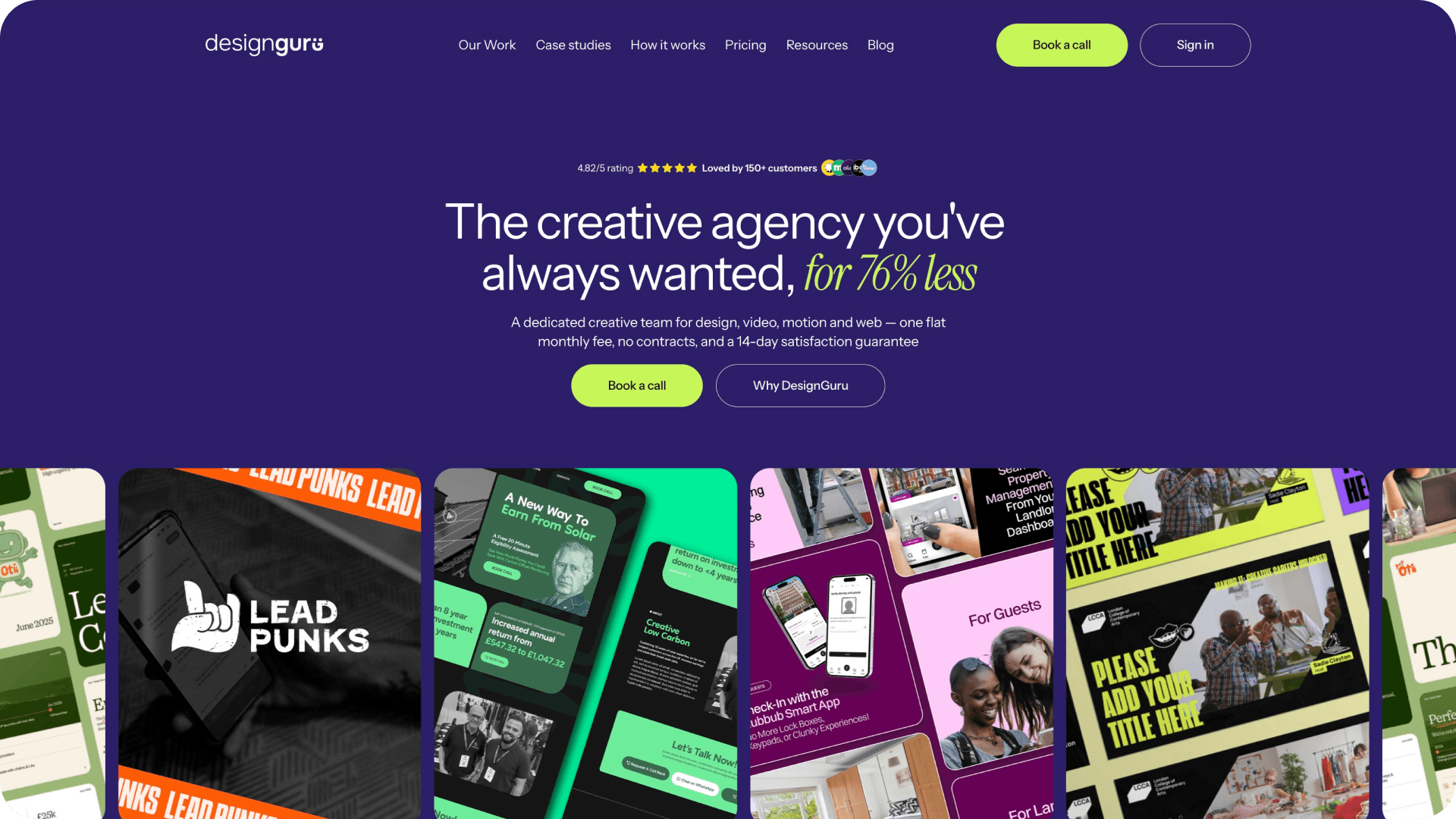
1. DesignGuru — best for multi-format creative without multiple vendors
DesignGuru is a creative subscription service that gives startups and SMEs a team of top-tier in-house designers covering design, video, motion and web on one flat monthly fee, with unlimited brief submissions, unlimited revisions and an average 48-hour turnaround, from £599 a month billed quarterly or £749 billed monthly.
The distinction we think matters is continuity across formats. A startup rarely stays “a social graphics client” for long. A normal growth cycle can move from investor decks and paid ads to sales collateral, landing pages, launch motion and product video without much warning.
Core starts at £599/month billed quarterly or £749 billed monthly and covers static social and ad creative, presentations, brand development, illustration, print and web graphics. Pro costs £799/month billed quarterly or £999 billed monthly and adds 3D static renders, video editing and motion graphics. Ultimate is £999/month billed quarterly or £1,249 billed monthly, adding landing pages, broader web/app design capability, account management and white-label options, with conditions applying to full-site, app and white-label work.
You can see the full plan breakdown on the DesignGuru pricing page and the wider range of 200+ creative services.
Where DesignGuru is strongest: craft continuity. Senior in-house designers work within an ongoing client relationship rather than treating every asset as an isolated transaction. You also have a dedicated project manager and portal, while working/source files are included.
The limitation: unlimited briefs do not mean unlimited simultaneous production. Requests and revisions move through a queue according to priority, complexity and available capacity. Core also stops short of video and motion, so a startup producing those formats regularly should price against Pro rather than using the lowest figure in the comparison.
For US buyers, there is another practical point: DesignGuru prices in GBP, so the amount charged in dollars will move with exchange rates.
Best for: startups already producing creative across several channels and trying to reduce the briefing, quality-control and handoff cost of running separate specialists.
Look elsewhere if: you have a very small volume of straightforward graphics, or your priority is the largest possible number of simultaneous active tasks rather than broad creative continuity.
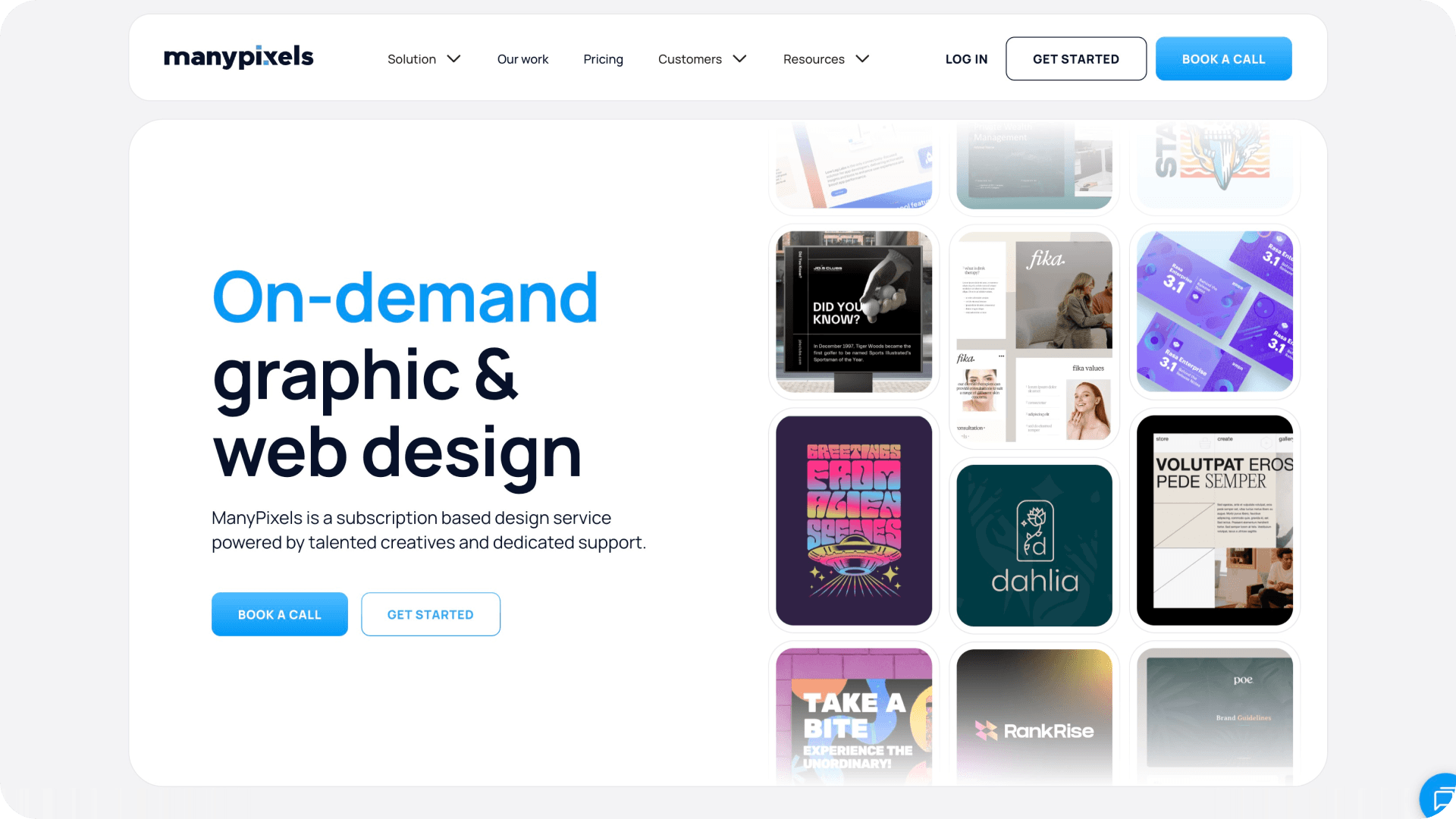
2. ManyPixels — best entry price for graphic and web design
ManyPixels’ Advanced plan starts at $699/month and combines graphic design, web design and illustration with one daily output, next-business-day delivery, a project manager and an additional quality-control layer. (ManyPixels)
That makes it a particularly strong option for early-stage teams whose recurring workload is mostly social, ads, presentations, illustrations and web design. Native source files and full copyright transfer are included across its plans. (ManyPixels)
Where ManyPixels is strongest: the entry plan is genuinely useful rather than artificially narrow. A startup can cover a sizeable portion of everyday marketing design and landing-page design for $699 without immediately moving up a tier.
The limitation: Advanced is a managed-team model with one daily output, not a dedicated part-time designer. ManyPixels’ Assigned Designer plan costs $1,399/month if you want to select a designer working in your timezone with Slack or Google Chat access. The Business plan costs $1,199/month and doubles daily output. (ManyPixels)
ManyPixels also allows customers to cancel without a fee and includes a $10/month pause option. (ManyPixels)
Best for: pre-seed and seed-stage startups with recurring graphic and web work that want professional project management without paying for a more embedded creative team.
Look elsewhere if: motion and video are central to the workload, or you place a high value on the same dedicated creative relationship from the entry tier.
3. Penji — best for two active workstreams at the entry tier
Penji Essentials currently starts at $995/month. It includes branding and logos, ad and social creative, email, print, presentations, illustration and other everyday marketing design, with an art director and two active workstreams. Penji advertises one-day turnaround for the plan. (Penji)
That changes the operational maths for a busy marketing team. If a campaign deck needs revisions while a batch of paid-social creative also has to move, two workstreams can matter more than a cheaper plan that only progresses one item each day.
Penji says its creatives are full-time employees rather than gig workers, while its Agency Partner tier explicitly adds the same assigned creatives, short-form video, motion graphics and broader agency workflow features for $1,995/month. (Penji)
Where Penji is strongest: a relatively high level of managed parallel production at the $995 tier, backed by an art director.
The limitation: Penji is no longer the obvious low-cost option it once was. Startups comparing purely on entry price now have cheaper alternatives, while recurring video and motion requirements push the useful comparison up to the $1,995 Agency Partner tier.
Penji includes source-file delivery and offers a 30-day money-back guarantee with no cancellation fees. (Penji)
Best for: small marketing teams with enough recurring work to keep two design streams moving and enough internal creative direction to brief them properly.
Look elsewhere if: your monthly workload is light enough that the additional concurrency will sit unused.
4. Kimp — best for high-volume graphics and video in parallel
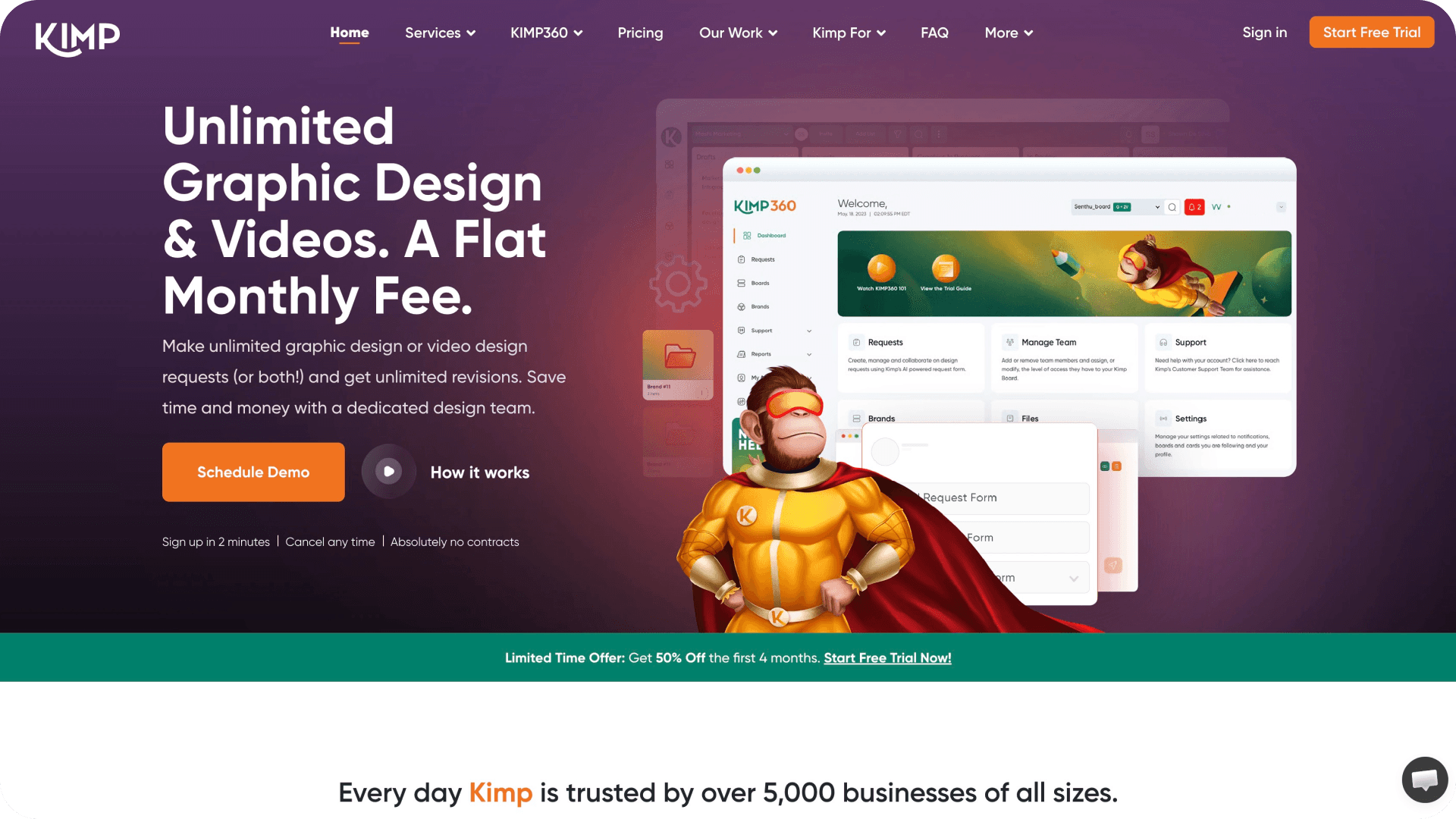
Kimp prices its Graphics and Video subscriptions at $1,397/month each, with its combined Graphics + Video plan at $1,697/month. (Kimp)
Its production model is the most interesting part. Kimp says a Graphics subscription can have three graphic-design requests in progress, Video can have two, and the combined subscription can have three graphics plus two video requests in progress at once. (Kimp)
That makes Kimp a strong operational fit for content-heavy companies. A launch can have static ads moving while an animated asset and video edit progress separately instead of forcing everything into one shared queue.
Where Kimp is strongest: parallel production. The combined plan is less about simply “including video” and more about preventing graphics and video from blocking one another.
The limitation: video requests have boundaries. Motion graphics and other animated video outputs can run to a maximum of around three minutes per request, while more complicated work takes longer. (Kimp)
Best for: startups publishing a steady cadence of paid creative, social graphics and short-form or edited video.
Look elsewhere if: you mainly need brand, presentation or static marketing work and would not use the extra video capacity.
5. Design Pickle — best for teams that want capacity sized around them
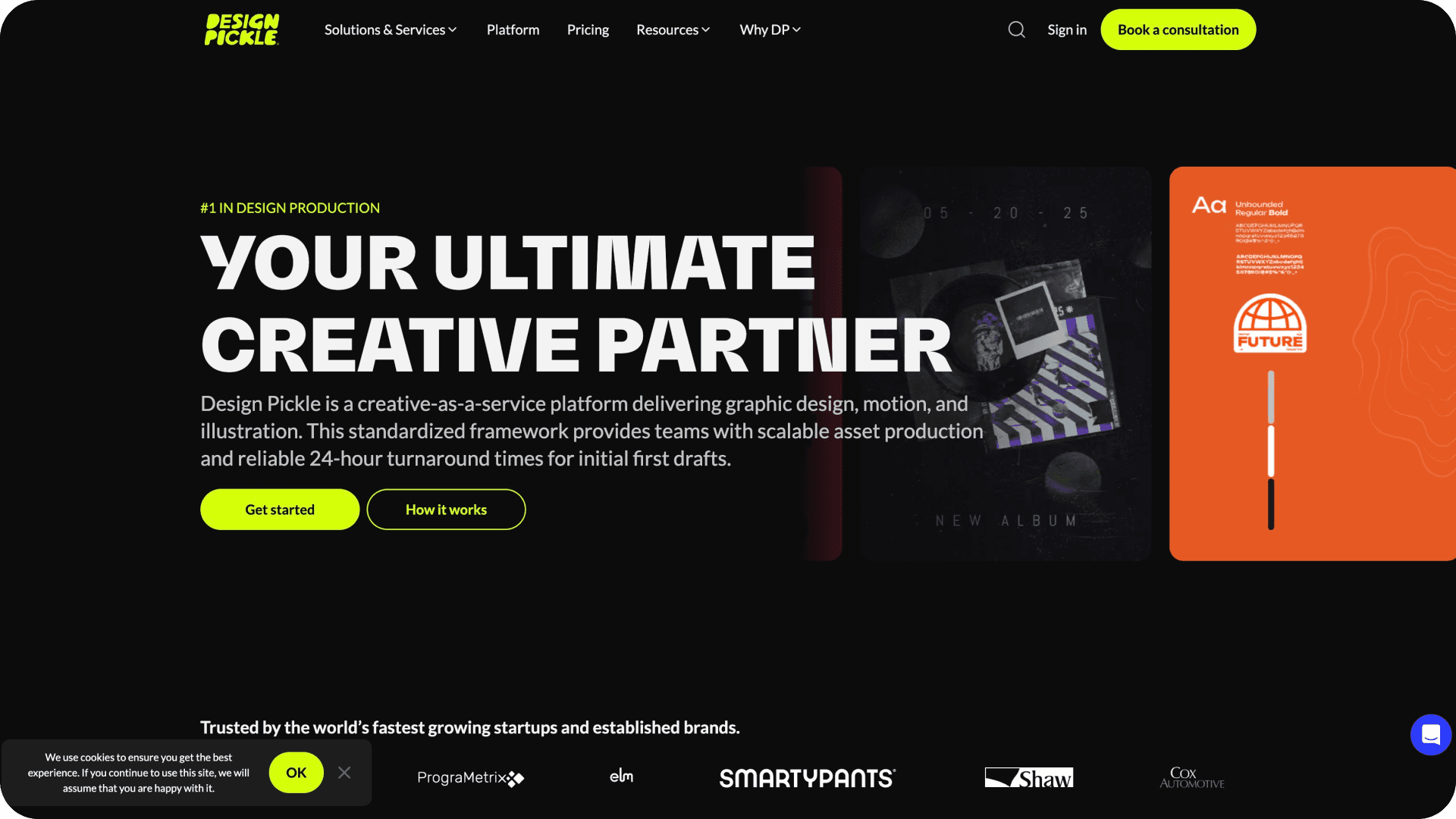
Design Pickle’s current model is notably different from the old fixed-price subscription structure. Pricing is now set after a conversation about the volume, turnaround and services required, while creative capacity is allocated through daily hours. (Design Pickle Help Center)
Its scope includes design, motion and video, and the platform adds briefing, asset management, integrations, routing and other creative-operations functionality. Design Pickle says first drafts are generally delivered by the next business day, with revisions included. (Design Pickle)
Where Design Pickle is strongest: configurable production capacity and workflow infrastructure. For a company that already knows roughly how many creative hours it needs, sizing the service around that requirement can be more useful than trying to translate everything into “requests”.
The limitation: you cannot compare the real price without speaking to sales. Plans also run on quarterly or annual billing cycles, so it is a less lightweight test than a genuinely monthly service. (Design Pickle)
Design Pickle states that customers receive full rights to the work it creates. (Design Pickle)
Best for: established startup marketing teams that value a mature production platform and can predict their recurring capacity needs.
Look elsewhere if: published pricing and a low-commitment first month are important to the buying decision.
6. Superside — best for enterprise-scale creative demand
Superside sits at a different end of the category. Its subscriptions currently start at a $15,000 monthly minimum on an annual commitment. (Superside)
That budget opens access to a much broader creative operation: design, strategy, video, photography, UI/UX, illustration, motion, 3D, AR, AI production and specialist creative support can sit under the same commercial relationship. Superside also structures the subscription around a recurring creative budget and its Superspace platform. (Superside)
Where Superside is strongest: depth and scale. A later-stage company supporting multiple regions, product lines or internal departments has access to a wider specialist bench than most startup-focused subscriptions are designed to provide.
The limitation: the minimum commitment is the feature and the drawback. A $15,000 monthly floor on an annual term only makes sense when the organisation has enough predictable creative demand to consume that capacity.
Best for: well-funded scale-ups and enterprise teams that need strategic creative capacity across multiple disciplines and stakeholders.
Look elsewhere if: you are still testing whether a subscription model is right for the company or your monthly creative demand is measured in a handful of briefs rather than campaigns.
Why creative quality matters more than the “unlimited” label
“Unlimited” is useful for removing per-project quoting. It does not tell you whether a service will produce better work.
Quality improves when the system retains context. The designer should not need the brand explained from zero every Tuesday. Feedback from a pitch deck should inform the next sales one-pager. A visual decision made during a landing-page project should not disappear when paid-social creative starts.
That is why we would inspect the continuity mechanism before comparing unlimited-request claims.
At DesignGuru, our model is built around senior in-house designers, a dedicated project manager and ongoing client context. Across more than 150 paying clients in the UK, US and Australia, that continuity is one of the mechanisms we believe matters most: the useful output of a subscription is not simply more files, but fewer resets between briefs.
You should apply the same test to every provider. ManyPixels offers dedicated-designer plans. Penji reserves same assigned creatives for its Agency Partner structure. Kimp works through dedicated teams. Design Pickle allocates production capacity. Superside builds managed teams around larger accounts.
Different mechanisms can work. What matters is knowing which one you are actually buying.
How much should a US startup spend on design?
The US Bureau of Labor Statistics reports median annual pay of $62,960 for graphic designers in May 2025. Web and digital interface designers had a much higher median of $104,000 in the same period. (Bureau of Labor Statistics)
Those numbers are useful context, but a subscription is not a one-for-one substitute for an employee. An in-house designer gives you dedicated working hours and deep organisational context. A subscription trades some of that dedicated capacity for flexibility, access to several disciplines and the ability to change the level of support without making another hire.
For most early and growth-stage startups in this comparison, the practical subscription band is roughly $699–$1,995 a month, or £599–£1,249 a month for DesignGuru depending on plan and billing basis. The right number depends on what the creative queue looks like, not the size of the company.
A startup shipping static marketing creative and landing pages can reasonably start near the bottom of that range. Add weekly video, motion, multiple brands or parallel campaign work and a higher-capacity plan starts to make more sense.
Which design subscription should your startup choose?
Choose ManyPixels when value and everyday graphic/web output are the priority. Choose Penji when two managed workstreams matter more than securing the lowest entry price. Choose Kimp when graphics and video need to move in parallel, and Design Pickle when you prefer a capacity-based model with more substantial workflow infrastructure. Superside makes sense once the creative operation itself has become enterprise-scale.
Choose DesignGuru when the main problem is fragmentation: one person doing decks, another editing video, someone else handling motion and a fourth supplier learning the website from scratch. Our model is designed to keep that work closer to one creative team, with plans scaling from static and brand production through video, motion and web.
Before committing, inspect three things: the work you shipped in the last 60 days, the maximum number of projects that needed to move simultaneously, and whether the entry plan actually covers those formats. If the answers point towards broad, recurring creative demand, you can compare the DesignGuru plans or see how our design subscription workflow operates.
FAQs
What is the best design subscription service for a startup?
There is no universal winner because startup workloads differ. ManyPixels is particularly competitive for lower-cost graphic and web production, Kimp is strong for parallel graphics and video, and DesignGuru is built for startups wanting broader creative continuity across design, video, motion and web. Compare formats, team continuity and production capacity before comparing monthly price.
What is the cheapest design subscription in this comparison?
ManyPixels has the lowest USD-denominated published entry price at $699/month. DesignGuru starts at £599/month when billed quarterly, or £749 when billed monthly. Currency conversion means the exact USD cost of DesignGuru will vary for US customers.
Is a design subscription cheaper than hiring a full-time designer?
It can be considerably cheaper in cash terms. The U.S. Bureau of Labor Statistics puts median graphic-designer pay at $62,960 a year as of May 2025, before employer costs. (Bureau of Labor Statistics) A subscription is not equivalent to a full-time employee, however: you are buying managed creative capacity and broader skill coverage rather than one person’s entire working week.
What does unlimited design actually mean?
It normally refers to how many requests or revisions you are allowed to submit, not unlimited simultaneous production. At DesignGuru, unlimited brief submissions and revisions are processed through a queue according to priority, complexity and available capacity. More complex jobs also take longer than the average 48-hour turnaround for standard tasks.
Which design subscriptions include video and motion?
DesignGuru adds video editing and motion graphics from its Pro plan at £799/month billed quarterly or £999 monthly. Kimp offers a combined Graphics + Video subscription at $1,697/month. Penji includes short-form video and motion on its $1,995 Agency Partner plan, while Superside includes video and motion within its enterprise creative scope. (Kimp)
Do I keep the source files from a design subscription?
Policies vary, so this should be checked before subscribing. DesignGuru includes working/source files with its plans. ManyPixels states that native source files and full copyright transfer are included, while Penji provides downloadable source files and Design Pickle states that customers own the work it creates. (ManyPixels)


Frequently Asked Questions
What do you mean by unlimited requests?
Once you’ve signed up, you can add as many design requests to your job list as you like. Your dedicated design team will tackle them one by one, based on the priorities you set. No hourly rates or per-project fees – everything is included in your package.
How do I make a design request?
Do I have to sign a contract?
How fast will I receive my designs?
What type of design work is included?


